It was about 15 years ago — back during my "previous life" as a ski instructor — that the first run of the day achieved sacred status for me. When my supervisor encouraged me to take a couple of runs before class to scout the terrain and get a feel for the day's conditions I, then in my mid 20s and a founding member of the 'whatever' generation, was skeptical. "I mean, seriously," I thought to myself, "I ski these trails every day. What's going to be so different about Rumrunner today? And if something had changed; if Smugglers' Alley has sprouted trees and become a gladed trail, or if Doc Dempsey's has morphed into the 16th hole at Augusta, wouldn't it be okay to discover this when I ski it with my class?" Besides, skipping first chair afforded me the luxury of a second cup of coffee and the opportunity to warm my boots before cramming my feet into them. "Honestly," I groused to the other instructors in the ski school boot room, "what's the big deal?"
Some weeks later on a Monday morning, I found myself charged with an upper level class of twelve year old boys. These kids were fast, aggressive skiers: long on energy and ego, short on prudence. They attacked every trail with a take no prisoners approach, with little interest in what I could tell them about successfully skiing the day's conditions. My only hope of actually teaching them anything was to impress them on their terms; I'd have to out-ski them. But my body, yes, even at the tender age of 26, wasn't quite up to the task, having been battered by winters skiing 100-plus days and Summers pulling weeds and planting trees. I would have to harness the vast wisdom of my quarter century on this planet and ski smarter than these eighth graders.
That evening before I fell exhausted into bed, I had hobbled outside for a couple of minutes to see what was going on with the weather. For instance, if it had been well below freezing and I had just spent my day skiing soft slushy bumps, I'd get ready for a firm surface in the morning and choose a groomer for my first run. Cutting through the corduroy on Chilcoot can be just as enjoyable as charging down Free Fall — more so on a day like this when the ungroomed terrain will look like a moonscape and ski like granite golf balls. If it had been snowing so hard on my deck that my hot chocolate had become diluted, I'd be looking at a great crop of fresh snow in the morning; if my toasty beverage had frozen solid, I would know to sharpen my edges and wax my bases for cold snow. On this night, however, the whipped cream was blown off the top of that hot chocolate and replaced by needles from the white pine down the road. If the stiff breeze kept up overnight, I'd expect windblown conditions and, if I knew where to look, some sweet fresh powder.
I got up to the mountain early on Tuesday, still aching from the trouncing I'd taken in class the day before, and caught first chair. The great thing about being among the first on the mountain is the solitude. Unless it's a powder day, complete with 8:00 am liftlines and hordes of snow seekers shouting their ways down the untracked trails, the first ride of the day is as peaceful as it gets. It's a good time for Winter wildlife watching; I've seen a pileated woodpecker near the Village Lift and an ermine running down Thomke's with a whole hot dog in its mouth. A resident porcupine generally spends his day wandering around the Highlander Glades after having a breakfast of bark 50 feet up a tree by the big rock on Sterling, and there was a report of a moose barreling down Link towards the Ski Patrol director one morning. Not to worry, though — these beasts really don't like people (with the exception of the Patrol director, it seems), so they'll stay out of your way unless you are carrying any possible lunch items for them.
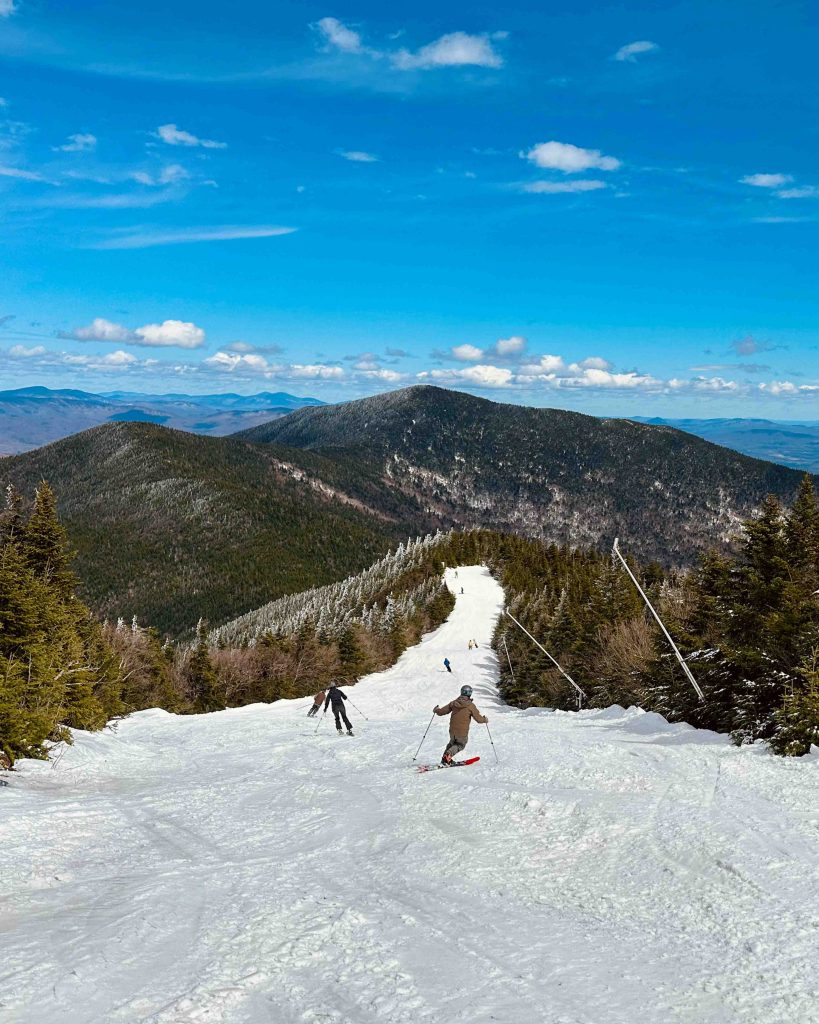
As I rode Sterling lift that blustery morning, I checked out the trail below and tried to figure out which way the wind had been blowing all night. In a steady wind, snow will be picked up and then deposited nearest the side of the trail from which the wind has been blowing. So if you notice that a lot of snow has built up on the skiers' left of Madonna's lift line (the right side as you ride the lift), the wind has been coming out of the southwest. Once you have this information, you'll be able to find fresh snow all over the mountain, knowing that it has built up on one side or another of certain trails. Beware this wind driven snow, however; it is much denser and heavier than powder and can stop you, quite literally, in your tracks if you're not ready for it. This knowledge was the first addition to my bag of tricks for the bomber boys I would be teaching that day. As I came upon one of these the wind-packed areas on the side of Harvey's Hideaway, I adjusted my balance and glided on top of the snow while the boys tried their usual method of charging through it with less than stellar results — they were taught the skiers' meaning of the phrase "yard sale," and as far as they were concerned, I was Picabo Street.
Another thing I noticed on my lift ride was that in the spots where fresh snow hadn't blown into the trail, the surface was scoured and had the consistency of styrofoam. Having experienced this particular condition before, I knew that it would be a challenge for the kids. This stuff will grab your edges and throw you in all different directions if you're not expecting it, so you have to stand balanced on your skis and think very hard about keeping your feet pointed in a consistent direction. This time, on Father Bob's, the boys again didn't try to finesse the conditions and ended up having to sort out whose poles belonged to whom while enduring some good-natured heckling from the lift. Again, I looked like a rock star. Resisting the urge to buff my fingernails on my jacket, I waited patiently for my class to recover, and gave them the "you won't get any better if you don't try new things" and the "remember to match your skiing to the conditions" lectures as they gathered about me, a bit chastened.
Most of the week went similarly. I prepared for the day with my early scouting runs, and I began to look forward to those first turns. The peaceful lift ride, the untracked groomers and the quiet Winter woods put me in the perfect mood for a busy day, and as an added bonus, I had a sneak peek at the conditions so I could prepare accordingly rather than being surprised by an expanse of wind slab on Black Snake or completely missing out on some blown in powder on Doc Dempsey's. By the end of the week, my class of bombers, having been slowed down by their mishaps and errors in judgment early in the week, learned to ski well in a variety of conditions — and their parents were thrilled to pick up their exhausted boys, all ready for naps, at the end of the lesson.
So give first chair a try. It gives you the chance to warm up for your day, whether you're looking to find the best snow on the hill, or to show your buddies what you learned during your stint on the World Cup circuit. As you get to know Smuggs, you'll discover the snow secrets of each of the trails, and that there is great skiing to be had all over the mountain -- you just have to know what it looks like.
Kathrine (Rena) Perkins has worked at Smuggs for many seasons as a member of the Ski Patrol, Snow Sport University, the Flower Crew, and the Hotline. She is a frequent contributor to Explore Smuggs. CLOSE We have all experienced fleeting moments when we felt somehow in harmony with everything around us. When some of us talk about Smugglers’ Notch as sacred ground, I start to think about those times on the mountain that I felt, not thought, but felt in perfect rhythm with all aspects of my environment. To me this starts to explain why many of us talk about experiencing “heaven” for a moment as we ski, snowshoe, snowboard, walk or just sit or stand for a moment observing our Winter surroundings.
Maybe you have felt this, similar to a focusing of your senses or warming of your core, as you have experienced the trails or woods on Madonna, Morse or Sterling mountains. If you have not, I hope you will.
You don’t have to be an expert to have this experience. You just have to be open and positive to letting it happen. I have seen people making wedge turns down novice terrain on Morse in which they were in moving, rhythmic balance, their skis appearing as extensions of their legs, rolling their lower body smoothly and efficiently to make beautifully round, evenly spaced turns. I have heard these people slide to a stop and with a deep breath express just how wonderful that it felt.
Could they have just experienced a bit of heaven on earth? Was it sacred ground? Whatever it was, and whether it produced quiet satisfaction or sheer exhilaration, it clearly felt good.
As an instructor watching their achievement, sometimes I’ve just had to say to myself, “That was so cool.” But those moments are available to everyone. Have you ever seen a chipmunk bounding through the woods in their somehow erratic and yet rhythmic manner and it just made you feel better? Or watched a ski class snaking its way down the slope, all with big smiles on their faces? It’s the same thing; watching anything that is moving in harmony with its surroundings just looks good, feels good, is good.
The mountain trails of Smugglers’ are where many of us experience this magic, which is why these mountains are our sacred ground. I’d like to share a story that serves as a personal example:
One time I was skiing down through the moguls of F.I.S. trail here at Smuggs, following a good friend, Randy Draper. He started down simply, slowly matching one turn to each bump, completing each turn across the top of each mogul. I followed, matching his turns. I was turning right at the same time Randy was turning right, so I was turning over the bumps while he was turning through the troughs.
Randy suddenly headed left up and over a bump and then back to doing one turn, one bump straight down the hill. I followed, still skiing in sync with him. Now Randy cut left again, riding over one bump, absorbing it and then hitting the next bump, extending to get flight. He landed on the back side of the second bump further to the left. I followed in his tracks, flying just after he flew, absorbing a bump just after he absorbed a bump, chasing him down the slope. Randy began to make big round turns that took us over two or three bumps for each turn. Our dance with the hill became more intricate.
Randy then returned to the easy pace of his first turns. He took a big swing back up the hill to the right until he almost stopped at the top of a bump. I continued to follow. He then proceeded to turn, one turn for each bump for a few more bumps. We slid to a stop in sync, grinning at each other.
Perfect day, perfect run, perfect dance.
I hope you can experience such a dance down the mountain. It can happen whether you are a first timer, sliding on a board on intermediate trails or tellying through the trees. You’ll find your own sacred ground.
A 32-year veteran of Smugglers’ Notch Resort, Peter Ingvoldstad knows the terrain of Smugglers’ three mountains like the back of his hand. As director of Smugglers’ Snow Sport University (SSU), he spent 28 years instilling a love of the mountains and winter sports in SSU students. Peter has recently taken on a new project: in Spring 2008 he was charged with developing and running the Smugglers’ Notch Gateway to Nature Program, a non-profit corporation that will serve as the home base for environmental education and discovery at the Resort. CLOSE